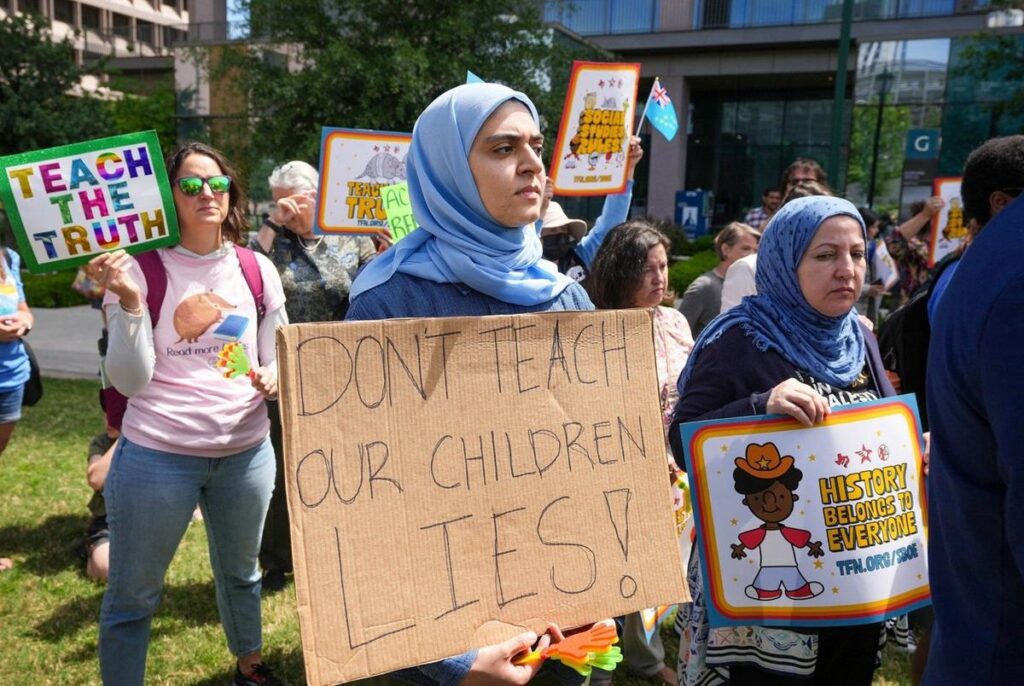
The State Board of Education packed the house this week as parents, pastors, and rabbis clashed over a proposal to put Bible passages on the mandatory K–12 reading list affecting 5.4 million students.
The crowd spilled out of the hearing room Tuesday and onto the Capitol Mall in Austin, signs waving, voices raised and the question at the center of it all was deceptively simple: should a Texas third-grader be required to read about the Road to Damascus as part of their public school English class?
The answer, depending on who you asked, was either a matter of foundational truth or a full-scale breach of the First Amendment.
Under a proposal before the GOP-leaning State Board of Education, Bible stories Jonah and the Whale, the Parable of the Prodigal Son, the Book of Job would become mandatory reading for students in kindergarten through 12th grade, woven into the state’s English curriculum alongside classics like Dr. Seuss and S.E. Hinton’s The Outsiders. The list stems from a 2023 state law requiring the Texas Education Agency to develop a catalog of high-quality reading materials; the agency came back with nearly 300 suggestions, and the religious selections quickly became the flashpoint.
Texas K–12 curriculum proposal key figures
| Metric | Figure | Context |
|---|---|---|
| Total Texas K–12 students affected | 5.4 million | ~1 in 10 U.S. public school students |
| Books on proposed reading list | ~300 | Includes Bible excerpts, classics, civil rights works |
| Bible passages proposed (K–12) | 10+ | Across multiple grade levels |
| Districts using optional “Bluebonnet” Bible curriculum | ~300+ | About 1 in 4 of Texas’s 1,207 districts |
| Errors found in existing Bluebonnet curriculum | 4,200 | Approved in 2024; corrections still ongoing |
| Per-student incentive for adopting Bluebonnet | $60 | Paid to districts by the state |
| Expected board final vote | June 2026 | Changes would take effect in 2030–31 |
| Year mandatory curriculum takes effect | 2030 | If approved — parents may opt children out |
Nathan Irving, a pastor and father of eight from Myrtle Springs, didn’t mince words before the board. “Truth is the only currency that never devalues,” he said. “This country and this state were founded upon a Christian worldview. Like it or not, it is true.”
“This list is a tool of proselytization that has no place in our public schools. There is a difference between teaching about religion and teaching religion and this list will force teachers to cross that line.” Rabbi Josh Fixler, Congregation Emanu El, Houston
The stakes here reach well beyond Sunday school debates. Texas is home to roughly one in ten of the country’s public school students, and what the state adopts tends to ripple outward textbook publishers follow Texas money, and curriculum trends set here often land in districts across the country within a few years. Texas became the first state to allow school chaplains in 2023, and last year’s Republican-led mandate to display the Ten Commandments in classrooms took effect statewide, though around two dozen districts later took them down over an ongoing lawsuit.
Aziel Quezada, a high school junior from an Austin liberal arts school, stood before the board and asked a question no one seemed ready to answer: “While political addresses, excerpts from the Bible, and creative pieces are all important — what can we say about representation of Latine students, of our Asian students, or even the rising number of queer students across the state? Where do they see themselves in these works?”
A vote is expected in June. By 2030, Texas classrooms will either look very different or a lot of lawyers will have had something to say about it first.