
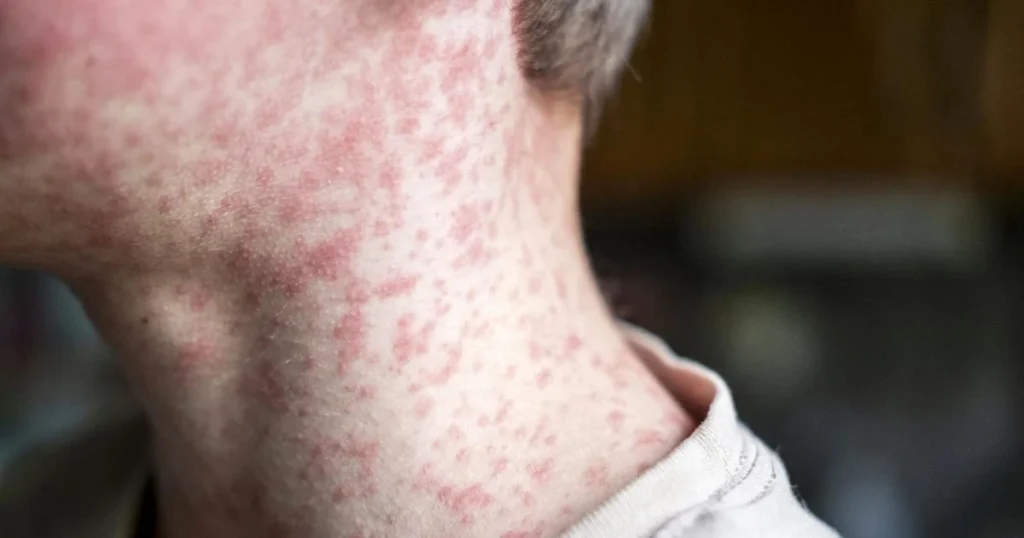
With 583 confirmed cases and the nation’s highest active outbreak, Utah has become ground zero for a public health crisis fueled by backsliding vaccination rates, social media confusion, and mixed signals from Washington.
1,714 Confirmed U.S. cases in 2026 vs 2,287 full-year 2025
33 States & jurisdictions reportingup from 16 outbreaks in 2024
94% Cases linked to active outbreaks 17 new outbreaks in 2026
93% Of patients unvaccinated or unknownconsistent with 2025 data
Leisha Nolan has been Utah’s state epidemiologist long enough to have seen a lot. But what she’s watching unfold right now stops her cold. “The fact that now we’re seeing 20 people every week in fact, probably more like 35 people every week get measles,” she said recently, “is amazing and terrifying.”
Utah is now the undisputed epicenter of the American measles outbreak of 2026. South Carolina which held that grim distinction for months with nearly 1,000 cases has not reported a single new infection since March 17, and its outbreak may officially be declared over on April 26. Utah’s, meanwhile, is still burning. Twenty-four new cases were confirmed in just the five-day window between April 3 and April 8. The state hasn’t seen numbers like this in more than 40 years.
And it’s not just Utah. Nationally, 1,714 confirmed measles cases have been reported across 33 states and jurisdictions as of April 9 making 2026 one of the two worst years for the disease since the United States declared measles eliminated back in 2000. That quarter-century of progress is now very much in jeopardy.
How It Started and Why It Spread
Utah’s outbreak didn’t begin with a bang. A handful of cases surfaced in southwest Utah in June 2025, clustered around Washington, Iron, and Kane counties a rural stretch of red-rock country where, as state data shows, only 60.7% of children ages 24 to 35 months are up to date on the combined vaccine schedule. The state average is 76.4%. To stop measles from spreading, a community needs 95% immunity. The math was always going to catch up.
By February, the virus had jumped northeast. The TriCounty Health District covering Daggett, Duchesne, and Uintah counties suddenly found itself at the center of the country’s most active active outbreak. Its own board of health had seen this coming: in a December 2024 open letter to the community, officials cited a jarring rise in vaccine exemptions, from 4.8% to 11.9% of local parents seeking to opt their children out of school-required vaccinations.
“We want all residents to understand,” the board wrote, “that individual decisions regarding vaccination impact us collectively.”
“I think we have a lot more just hesitant people who have been confused by mixed messages on social media. This kind of vaccine hesitancy is different than the staunch opposition to vaccination found in some other communities.”— Local TriCounty Health official, speaking to Healthbeat, April 2026
The disease has now touched the University of Utah campus and multiple Salt Lake-area schools. Exposure sites have been logged at churches in Price, sporting events, and clinics across the Wasatch region. During the 2024–2025 school year, about 10% of Utah’s in-person kindergarten students had a vaccine exemption or missing documentation a number that represents real, exploitable gaps in the firewall that once protected this state.
Active Hotspots Across the State
Southwest Utah
Washington, Iron, Kane, Beaver & Garfield counties — where outbreak first emerged in June 2025. Vax rate: 60.7% (children 24–35 months)
TriCounty District (Vernal area)
Daggett, Duchesne & Uintah counties — now the fastest-spreading node; MMR demand up 500% from prior year
Salt Lake Valley
University of Utah campus & area schools reporting exposure sites in March–April 2026
Carbon County (Price area)
Exposure confirmed at local LDS church, March 1, 2026; watch period extended through late March
The Vaccine Story and the Noise Around It
About 90% of Utahns overall are vaccinated against measles, according to state health officials. That sounds reassuring. It isn’t not when 95% is the minimum threshold needed to achieve herd immunity, and not when the pockets of unvaccinated people are concentrated in specific communities where the virus can gain a foothold and run.
Of the 583 Utahns diagnosed with measles since the outbreak began, 485 were unvaccinated. Fifty-nine had the vaccine a number that sounds alarming until you understand the math: when viral load in a community is this high, even a vaccine that’s 97% effective will occasionally fail the 3%. Those vaccinated patients, state officials emphasize, tend to have milder illness and recover faster.
The good news is that fear is driving action. MMR vaccinations statewide are up 31% compared to the same period last year. In the TriCounty area alone, vaccine administration has surged 500%. Parents who were hesitant are now calling their pediatricians.
“A small percentage of those people are unlucky and get the virus. Happily, people who are vaccinated even if they do get that infection have a milder illness and tend to recover much more quickly.”— Leisha Nolan, Utah State Epidemiologist
What America Stands to Lose
The stakes extend well beyond Utah’s borders. The Pan American Health Organization is scheduled to evaluate U.S. measles data in November — right after the midterm elections. If continuous transmission is found to have occurred for more than twelve months, the United States could lose its measles elimination status, a designation it has held since 2000. Canada already lost that status. So have the United Kingdom and five European countries.
A report from the Common Health Coalition puts a fine point on the cost of letting vaccination slip: a 1% decrease in childhood MMR coverage could cause 17,000 measles cases, 4,000 hospitalizations, and 36 preventable deaths per year. Three children died from measles complications nationally in 2025.
What Parents in Utah Should Know Right Now
State health officials say children who are 6 to 12 months old should get an early, extra dose of the MMR vaccine if they live in or near an outbreak area. Anyone exposed to measles can get the vaccine within 72 hours to reduce risk. If you think your child may have measles — fever, rash, red eyes, cough, runny nose — call your provider before going in, to protect others in the waiting room, especially pregnant women and infants. Check the Utah DHHS measles dashboard for current exposure locations.
You May Also Like
The days are hot, but so are the nights. That’s a problem, experts say
A heat event gripping the Eastern U.S. is keeping nighttime temperatures unusually high, blocking the body's natural cooling window.

Even fans who don’t speak Spanish are watching the World Cup on Telemundo. Here’s why
Fans who don't speak Spanish are choosing Telemundo's World Cup broadcasts for passionate announcers and uninterrupted field coverage during hydration breaks.

The effort to get benefits to American civilians exposed to toxic burn pits
A federal burn pit law covered veterans but excluded thousands of American civilian government workers exposed to the same toxic smoke. Legislation to fix that is now moving.